
 Laryngeal paralysis is a respiratory condition where the normal protective mechanism in the throat is malfunctioning, causing difficulty breathing during exercise/excitement and increased risk of aspiration pneumonia during any swallowing. It happens because the muscles that control the laryngeal cartilages, the "barn doors" at the front of the trachea that open for breathing and close to protect the airway when swallowing, are not getting adequate nerve stimulation to function correctly. Lar Par can be suspected by the harsh/louder than normal noise your dog (or rarely your cat!) makes when panting, and/or by increased coughing or hacking after drinking or eating, and is confirmed by examining your pet's laryngeal cartilages under light and short-acting anesthesia with propofol or dexmedetomidine anesthetic. It is usually a primary nerve disease, or neuropathy, and originally it was thought to be a problem only of the nerve supplying the laryngeal cartilage muscles. For dogs, it is now thought that most Lar Par is part of a more generalized condition called Geriatric Onset Laryngeal Paralysis and Polyneuropathy, because most dogs with this condition are older and are also experiencing hind end mobility issues that are caused by nerve dysfunction rather than arthritis. (These dogs may also have arthritis, but the main problem is a neuropathy of many nerves, hence polyneuropathy.)
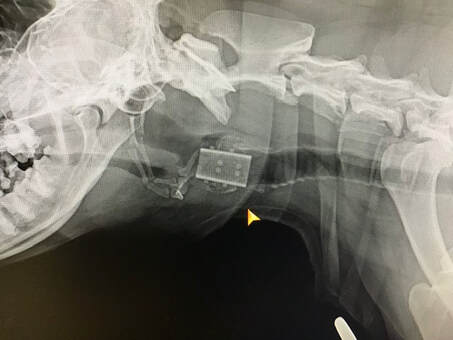
Lar Par and GOLPP are progressive diseases; they start with mild signs and get worse over time. Progression of the mobility problem is an important part of this, but the Lar Par issue needs the most management. Often the Lar Par seems to suddenly get worse when warm weather arises because dogs must use their breathing to cool themselves down. In cool dry weather there is not much need for this, so progression of the laryngeal dysfunction is hidden; when the weather changes and the ability to cool down by breathing faster is needed is when the problem becomes apparent. Initial management of Lar Par is to keep your pet out of the heat and humidity as much as possible, often requiring air conditioning, and to limit exercise and excitement so breathing can stay slow and calm. (When the "barn doors" are not opening fully your pet is breathing through a bottleneck; this isn't a problem when breathing slowly and gently, but can be a very big problem if your pet needs to breathe faster or harder.) Additionally, the stress from any amount of struggling to breathe through that bottleneck can trigger an asthma-like response where the airways in the lungs also close down, causing that small bottleneck to become a large bottleneck, and respiratory distress becomes respiratory crisis. Sometimes anti-anxiety or mild sedative medications are needed to keep our pets from having a respiratory crisis. And eventually it will progress to the point where surgery may be needed. Our Great Dane Josephine had Lar Par and GOLPP, so we ended up with a better understanding of this disease than many vets (there is only so much new info each vet can realistically keep up with). In our journey with Josephine, and now others, we have found some additional treatments to be helpful. -- The tricyclic antidepressant (TCA) drug doxepin increases levels of certain neurotransmitters in the brain and can help improve nerve function (all nerve function) in some dogs with GOLPP. For some dogs the improvement within just a few weeks is dramatic, so it is definitely worth trying. Josephine had a so-so response, but was definitely better taking it than not taking it. Others are sedated but have no improvement at all. There is a dose range for this drug, and some trial and error may be needed to find an effective dose with minimal sedation for each pet. -- We also found a combination of herbal/nutritional supplements (the Nerve Tonic and Respiratory Tonic from Pet Health and Nutrition Center) that did seem to help Josephine especially with her ability to walk, so she stayed on them for life. My personal belief is that starting doxepin and/or these nutritionals early in the course of the disease will be the most effective management. -- Laser therapy was used by one dog's owner prior to our contact, and she did find it to be helpful to moderate the severity of her dog's clinical signs, and thus slow the progression of the disease. Laser therapy is reported to be especially helpful for nerve and muscle diseases, and is becoming increasingly available through regular vet offices and rehabs. -- Some dogs with GOLPP also have a neurogenic (nerve-function-induced) excess thick mucus production in the back of the mouth / in front of the airway. This increases the bottleneck, the noise, and we also feel the risk of aspiration. The anti-nausea medication maropitant (generic of Cerenia) has been found to help decrease this mucus production, which improves breathing and decreases aspiration. This excessive mucus production can be seen when Lar Par is diagnosed, but most vets will not know it is neurogenic in origin or that maropitant can help, so may not note it's presence or severity. Maropitant will probably need to be given for life for affected dogs, but I do wonder if it can be decreased over time to a lowest effective dose, especially for the dogs that do respond and stay on doxepin. Progression of GOLPP varies from dog to dog, and for some eventually medical management of the Lar Par will not be enough. For those dogs, surgery called a "tie back" is the gold standard, where one of the laryngeal cartilages is pulled mostly to fully open and "tied back" out of the way of the air flow. This opens the airway for breathing, but does potentially increase the risk of aspiration pneumonia. (Lar Par increases the risk of aspiration pneumonia, the tie back and other surgeries increase that risk, a stent, discussed below, increases that risk, and there are probably stats on each one, but I personally don't think there is a large difference between these 3 options.) There are other types of surgery for Lar Par, but the tie back has the lowest overall complication rate so far. The advantage of surgery is that your dog can instantly breathe easily without the risk of respiratory crisis which, if/when your dog gets to the point of having or almost having respiratory crisis, literally is saving your dog's life. Surgery is done once, with a low complication and/or repeat procedure rate. Also, the surgery uses a part of the laryngeal cartilage that is not actually in the airway to tie to a nearby cartilage, so there is no added inflammation or complication of surgery IN the airway. For any future anesthesia, there is no change to your vet's ability to place an endotracheal tube in your pet's airway like he/she normally would. The disadvantage of surgery is that you need to schedule this with a referral surgeon, which may or may not mean multiple phone calls to find one who can accommodate your/your pet's schedule; travel to a referral facility while still trying to minimize stress; moderate cost; low risk that the vocal folds start contributing to the breathing bottleneck; etc. Some dogs are not good candidates for a tie back, as cartilage can degrade with time, putting in question the ability of the cartilage to hold / be held by a suture, or the vocal folds might already be everted and contributing to the respiratory distress. (This would be the call of the referral surgeon.) An experimental alternative to surgery, or a temporary aid until surgery can be performed, is the placement of a sterile silicone stent. Several papers have described small studies of dogs that have had a "tracheal" stent placed in the laryngeal area to hold the cartilages partly to mostly open, instead of the tie back. There is a Facebook group moderated by a very well-informed individual who strongly advocates for the laryngeal stent. The advantages of the stent are that your regular veterinarian can place the stent (he/she must be willing to learn how, but it has a very short learning curve; a couple long instruments are the only special equipment needed; and we will gladly help guide him/her); the cost is much less than for a tie-back; the vocal folds are pressed back into the sides of the airway, eliminating any contribution to the breathing bottleneck; and the result is also evident as soon as your dog wakes from anesthesia. The disadvantages of a stent are that some dogs have bad breath afterward (see below for more on that); their bark is forever hoarse; not many general practice vets are willing to try this yet; they must be ordered ahead of time, (your vet won't have these on hand otherwise); they are made in Spain so ordering is a little more complicated, (not horribly so, but most vets don't have any extra time as it is, so this may be an obstacle); the correct size for Lar Par is not the same as the size for tracheal issues so both purchaser and customer service rep involved in ordering must be aware that this is for laryngeal paralysis (which seems to be less of an issue these days); it does need to be sterilized prior to placement (but can be processed by your vet like other surgical instruments in an autoclave); it does require 2 long-handled instruments that many but not all vets have on hand so may need to be purchased specially for this; there is a very real risk your dog may cough it out, if not appropriately medicated and exercise-restricted, within the first month and it then needs to be recleaned and replaced; it DOES affect your pet's ability to have an endotracheal tube placed for this and future anesthesia, which rarely might present a problem (for this procedure we use propofol injectable anesthesia, so pets with allergies to egg or chicken will need to have the newer anesthetic alfaxalone instead); and codeine is the drug used in the studies to prevent the dogs from coughing it out in the first 30 days, so your pet needs to be able to tolerate codeine. Like doxepin, there is trial and error in figuring out what codeine dose works without excessive sedation, and at the risk of your pet coughing it out and having to replace it, YOU need to be able to deal with a zombie/sleeping pet that doesn't cough, until you figure out the dose that prevents cough but also allows fairly normal function. Many dogs develop a little bit of a tolerance to codeine (and doxepin) after a week or so, but even if your dog is sedated the whole month post-op, it's only 30 days in the rest of your pet's life. I think figuring out the codeine dosing is easiest for a dog who has already tried doxepin and is either on a regular daily dose that is effective or has found it to be ineffective and will not be starting it at the same time as codeine. Additionally, since the first 3 days after placement of a stent is the most likely time for it to migrate or be coughed out, we highly recommend you stay local to the hospital (such as a pet-friendly hotel) for 3 full days after the stent, just in case it needs to be replaced. Our experience with Josephine with her stent was very positive, but she did have halitosis as the studies do mention is possible. Any implant into the mouth or upper part of the throat is going to have an individual's own bacteria cover, or colonize it. Usually this is going to be a microscopic layer, and is not significant. Unfortunately, the bacteria from Josephine's mouth that colonized her stent were an especially stinky variety called pseudomonas, and her stent made a small shelf / cul-de-sac on top of the front part of it (allowing that many more pseudomonas bacteria to thrive there), making her breath smell like month-old gym socks. Subsequently, we have trimmed the stents before placement to minimize this shelf effect, and minimize bad breath. The studies suggest the stent needs to be removed and replaced with a new sterile or resterilized stent every 3 months, but at least one study mentioned a dog with a stent for years that was not replaced, and we are advocates of NOT manipulating the stent once it is stable. None of the dogs that we have placed stents for have undergone this every 3 month replacement, and we don't see any complications having arisen because of that. In fact, with our own dog Josephine we did anesthetize her with the plan of removing and replacing like the papers suggest, but at 6 months post placement, that stent was so thoroughly stable that removing would have caused damage to the tissues and we opted to leave it alone. Yes, there was some mild tissue inflammation at the stent, and she had horrible halitosis from the pea-sized colony of pseudomonas, but neither affected HER quality of life and neither needed to be treated. And that brings up the subject of whether the stent is a permanent solution or a temporary one. For one dog in one of the studies, the stent was in place for many years at the time of the write up; for all of the dogs we have placed stents for so far (9 as of February 2026), we have not removed/replaced any of them, and they have not been on antibiotics for the halitosis (one for aspiration pneumonia we diagnosed AT the time of stent placement). One of our local patients is going on a year in March, without complication; our second stent patient (the first after Josephine) had hers for 2 years, also without complication. There are vets in Europe who are also placing stents instead of performing tie-backs, and they are finding the same thing. Most dogs who have a tie-back or a stent eventually pass from GOLPP's mobility issues or other medical problems unrelated to the Lar Par. My opinion is that a laryngeal stent seems a viable alternative to a tie-back, for a variety of reasons. Alternatively, the stent can be a temporary solution to prevent a respiratory crisis while waiting for a tie-back or deciding how manageable the rest of your pet's GOLPP signs are if you are not sure about a tie-back.
2 Comments
 We are excited to offer our puppy and kitten kits online to our clients! As always, if you have any questions please reach out to us directly. Helpful resources...
© 2020 Charlestown Animal Hospital
All Rights Reserved. Do not duplicate.  To Our Valued Clients, We want to let you know we are closely watching the rapid developments with the COVID virus. While we plan to remain open with our normal business hours to care for your pets, we have put some plans in place for our clients that are either ill, fall within the “risk zone”, or are practicing social distancing. - If you are healthy, have no prior contact with a COVID positive individual, and have not recently returned from a foreign country in the past 14 days, please schedule your appointment as usual by phone. - If you prefer, or are ill, we are pleased to offer drop off appointments. A technician can bring your pet in from your car and we can take a complete medical history over the phone. You are welcome to wait in your car during your pets examination. The attending veterinarian will call you when the exam is complete to discuss a treatment plan or visit recap. Payments can also be taken over the phone. If you prefer this option, please call ahead to let us know and again upon your arrival. - Parking lot delivery and pick up. We are able to deliver medications and food directly to your car. Call us at (603) 826-3300 so that we can have your order ready in advance, and again when you are in the parking lot. You also have the option for us to mail your pet’s medications or, you are welcome to order directly from the online pharmacy. Please do not be offended that we will not be shaking hands or giving hugs although we would love to! As always, we do a thorough wipe down of exam rooms, chairs, and doorknobs after each appointment. If you have any questions or concerns during this time, please do not hesitate to reach out to us. 3-24 Update: We are still open with our normal business hours to care for your pets. Effective immediately, in addition to our current plan in place, we are spacing out appointments so clients are less likely to come in contact with each other and we have fewer people in the facility at one time. We are still offering drop off appointments and are happy to meet you in our parking lot. We are also no longer seeing non-emergency Tech nail trim / anal gland expression appointments. Please reach out to us by phone with any questions or concerns. 3-26 Update: We want to remind everyone that even with the "stay-at-home" order in place, we are considered an essential business and will remain open to care for your pets. We have taken many precautions to keep you safe while your pet is seen and also offer drop off appointments which allow you to wait in your car while your pet is cared for. We are also able to mail all medications directly to your home either via our online pharmacy or from the office here. As always, if you have any questions or concerns. Please give us a call. Please bookmark this page for continued updates. Thank you.  In our product spotlight for the month of February, National Pet Dental Health Month, is Perio Support powder.
When it comes to dental health, or periodontal health, we are looking to prevent or minimize: - the combining and hardening onto the teeth of food components with minerals in the saliva (plaque and tartar formation), - gum inflammation, swelling, redness and infection (gingivitis), - loss of gum tissue around the teeth (gum recession), - and infection of the tooth roots (periodontal infection) with loss of bone around the teeth leading to permanent tooth loss. Perio Support powder contains zeolites, a mildly abrasive material to help minimize new plaque and tartar formation. There are multiple components that can decrease inflammation, and some to improve the immune system of the gum tissue, both of which help the gums resist gingivitis, gum recession, and tooth root infection. It also contains probiotics to support a better bacteria balance in the mouth, which may decrease the number of “less desirable” bacteria associated with bad breath and periodontal infection. It comes in 4.2 and 16 ounce bottles of powder to sprinkle on your pet’s food to make his/her regular diet into a “dental diet”. Because of the black licorice flavor to the powder, some pets absolutely love it and some do not. Any bottle purchased at the animal hospital come with a “palatability guarrantee”, which means that if you try it and your pet won’t eat it, then you get a full refund when you bring the bottle back (in a timely manner). Even if your pets takes it at first but then changes his/her mind, you still get a full refund. Even though I’m not a fan of black licorice flavor, my dogs do like it. Our little old dog Roxie came with horrible teeth and periodontal disease. The Perio Support after her first cleaning/dental care appointment really helped improve her oral health and comfort. She still had some age-related issues, but she didn’t lose many teeth at the next scheduled dental visits as long as she was taking the Perio Support powder. Other great things about Perio Support are that it is made by Vermont company VetriScience, it is made in the USA, and it carries the important National Animal Supplement Council (NASC) seal! (The NASC seal is earned only after rigorous testing for product quality and quality control). Written by Dr. Claire Lindo |
Archives
February 2023
Categories |
 RSS Feed
Site powered by Weebly. Managed by Hostgator
Photo from Stonnie Dennis Dog Photography